
Dip & Bake Coil Construction
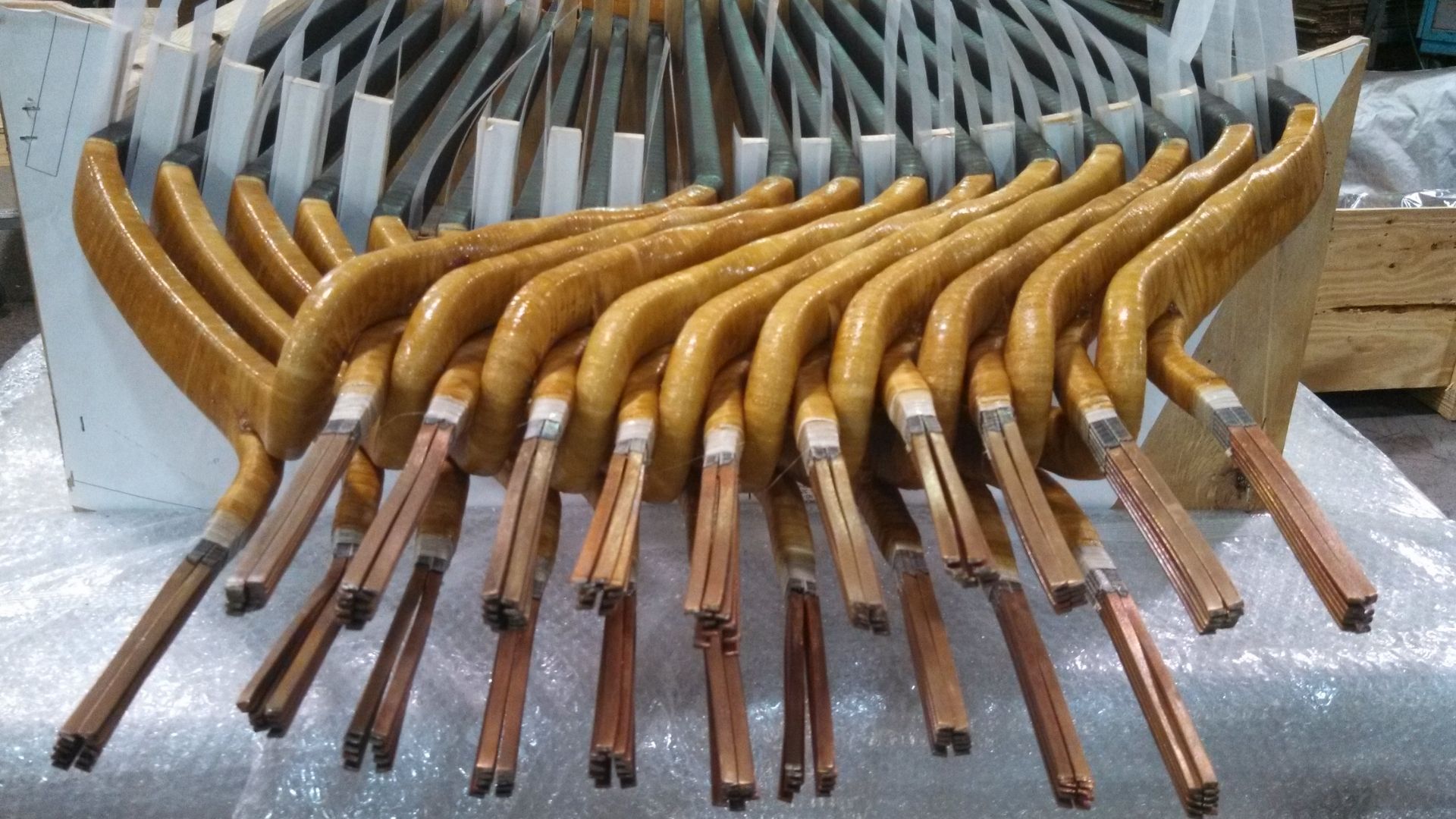
Quality CMI Dip & Bake insulation systems keep your form-wound AC motors running longer and more reliably. The CMI Dip & Bake insulation (rated Class F or higher) is specially designed to protect AC form-wound coils.
Dip & Bake insulation is ideal for drip-proof and TEFC motors and generators originally wound with Class A, B, or F insulation systems, and for voltages up to 7,200. Semiconducting paint is applied to the slots of all coils rated 6,600 volts or higher to provide corona suppression. The Dip & Bake system has proven highly reliable in industrial, utility, and continuous-process applications. CMI has used and improved it on both new and rewound motors and generators.
The CMI Dip & Bake Construction Process
Turn-and-strand insulation is selected to ensure each insulation system design provides maximum motor uptime. Coils are wound with rectangular copper conductors, insulated with a minimum of quad enamel coating whenever possible. Some applications may require single- or double-glass-over-film combinations or mica turn-taped construction.
Conductors are pressure-bonded and sized to align the turns, providing a highly flexible yet mechanically stable coil loop. The coils are then shaped to precise dimensions in a coil spreader.
Coil leads are then insulated with acrylic sleeving or multiple layers of tape, depending on the voltage or motor application. All sleeving has a Class F temperature rating and a 7,000-volt dielectric rating for maximum protection.
Coil ground insulation may consist entirely of micamat tapes or a combination of tapes and slot wrappers, followed by Dacron glass or glass armor tapes. Multiple layers of these tapes and wrappers are used depending on voltage, motor application, or specific customer requirements.
After the coils are insulated, they are given a dip & bake in a polyester insulating resin for added sealing protection.
Dip & Bake testing ensures that rewinds and form-wound replacement coils using Dip & Bake insulation systems are built to strict quality standards and must pass numerous quality checks.
Single coils are surge tested at values well above IEEE standards. The completed coils can also be tested to the IEEE high-potential standard for new motors of twice the rated voltage plus 1,000 volts.